
Vol. III, No.
14
ONE SHILLING
APR.-MAY '49
Fantasy on Television
JOHN CARNELL
reports on
'THE TIME MACHINE'
FANTASY REVIEW
Volume 3 No. 14 page 2
TELEVISION
TAKES TO
FANTASY
By JOHN CARNELL
Over fifty years
ago, a young writer who was destined to become world-famous for his imaginative
conceptions of things to come sat down and wrote his first successful
fantasy. It 'was the story of an inventor who fashioned a machine on which
he journeyed into the future, stopped off to take a look at mankind in
the year 802701, and traveled on into the dim vistas of the world's end
before returning to the security of the 19th Century. It is said that
Wells' tale of "The Time Machine" set the early British film
pioneer, Robert Paul, thinking about the possibilities of the screen play.
It has even been suggested that the author himself may have been influenced,
if only subconsciously, by the awakening technique of the new art form
when he wrote his amazing tale. At any rate, he and Paul got together
in a project which, if it had not failed for lack of capital, might have
resulted in the filming of the Time Traveller's adventures, or, at least,
in an attempt at something which even today's film-makers Would scarcely
dare to tackle.
But could he possibly
have dreamed, in 1894 (any more than we did only a few months ago), that
"The Time Machine" would be presented to an audience of thousands,
sitting comfortably in their own homes before their television screens
in 1949? In spite of difficulties which were readily recognized, such
an ambitious production was not too much for the B.B.C. to attempt; and
if they did not succeed to the extent of satisfying the armchair critics
of the Press, one of whom described it, with a yawn, as "The Crawl
of Time", at least they were quick to see in the brave try the making
of television history.
There were, actually, two attempts, the first having caused such a furore
of caustic comment* that several revisions
calculated to improve the whole production were made in the second showing.
Even then viewers who looked-in on both versions found difficulty in deciding
which version was the better. But it was generally agreed that "The
Time Machine" had been worth the time and trouble, and the money,
spent on it. For the fantasy fan, especially, it was a momentous event,
indicative of the shape of things to come in TV.
The first announcement of the play caused quite a controversy over the
courageous bid of producer Robert Barr and scene designer Barry Learoyd
to present this corner-stone of science fiction in a medium to which,
it seemed to the skeptics, it was quite unadaptable. The discussions between
the producer and his staff over the ticklish technical problems it raised
were the
subject of an article in The Radio Times. How could they give an impression
of the passing of hundreds of thousands of years in the space of some
three minutes? How to design sets strictly limited in size to really look
like a bizarre world of the distant future? How to show the Morlocks in
their dark underground domain?
| FANTASY REVIEW
A Journal for Readers, Writers and
Collectors of Imaginative Fiction
BI-MONTHLY: ONE SHILLING
Editorial, Advertising and Publishing Office: 115
Wanstead Park Road, Ilford, Essex.
Subscription rates: In Great Britain and Dominions (except Canada)
6/- per year. Single copies, 1/-., post free. In Canada and U.S.A.,
$1.50. per year. Single copies, 25c., post free.
Vol. 3, No. 14 Apr.-May. '49
Editor: Walter Gillings.
Associate Editors: John Carrell, J. Michael Rosenblum, D. R. Smith,
Arthur F. Hillman, Fred C. Brown, Frank Edward Arnold, J. O. Newman,
A. Vincent Clarke.
American Correspondents: David Kishi (New York), Forrest J. Ackerman
(Hollywood), Sam Moskowitz (Newark, N.J.), Bob Tucker (Bloomington,
Ill.) |
An article in Illustrated,
with three pages of stills and pictures of the production in the making,
appearing after the first showing, revealed how some of these difficulties
were overcome. It also reported how it was proposed to vary the second
production to meet the criticism that the whole thing amounted to no more
than "an exercise in elementary fretwork," in which buildings
of the future had been cut out of futuristic photographs or plastic spheres,
and mounted in frames only eight inches high before being made into film
sequences.
My own reaction, on the first showing, was that "The Time Machine"
was a first-class job of television, considering the limitations of Alexandra
Palace with which all viewers are familiar through the Press. I thought
Mr. Barr had succeeded, as far as anyone could expect with such a difficult
subject, in making the show enjoyable and, at the same time, understandable
to the majority of viewers. But the gentlemen of the Press, ever ready
with their blunt instruments to do murder for the sake of a new angle,
thought otherwise; so much so that the B.B.C., for the second showing,
made changes in the dialogue and chopped pieces from the time-travel sequences
in an attempt to pacify the reviewers and give those of its viewers who
found it hard to swallow a better chance to appreciate the implications
of the idea right from the first scene.
Condensed to a little less than an hour, the play opened with the Time
Traveller, played by Russell Napier, discussing his theories with his
friends after dinner. He shows them a model of the Time Machine, and while
they watch. it slowly fades from the table on which it is resting. Then
he shows them, in another room, the actual machine on which he proposes
to travel, but they are even more skeptical and leave him to his reverie.
Impatient to prove his case, the Traveller mounts the machine (a beautifully
designed contraption) and sets off into the future.
| 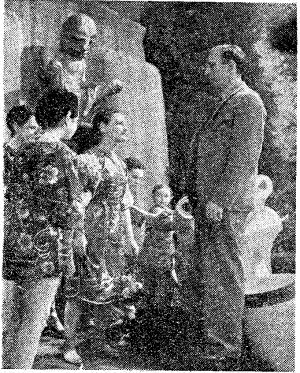
The Time Traveller meets the Eloi.
A scene from the television version of
"The Time Machine."
|
In
the first showing, after a brief interval in which the hands of the
wall-clock recorded the passing of many hours, the lights began to
dip and rise to indicate the passage of the days, and as this effect
speeded up the walls of the room gradually dissolved. In the second
performance this was cut out, killing the impression of fast-moving
time. But, outside, the sun moves ever more swiftly across the sky
until it is a continuous band of light, rising and falling to indicate
the equinoxes, and throwing into vivid relief the changing shapes
of successions of buildings which become more startlingly futuristic
as the Traveller flashes through the ages.
Eventually the buildings are replaced by domes and peculiar stilted
erections, and as they fade the Traveller arrives in the era of the
Eloi. These were played entirely by small women and children, the
Traveller towering above them like a god, which they imagined him
to be, and the difficulty of their speech was easily overcome by limiting
their vocabulary to shrill laughs and twitterings.
The action became slower as the Traveller, having surveyed his surroundings,
discussed the past and mused upon the present with the uncomprehending
Weena. but grew in suspense with his discovery of the fact that the
Morlocks had abstracted the Time Machine and his futile efforts
*
Especially by Observer critic W. E. Williams, who condemned "the
ill-fated endeavour to confine the cosmic vision of H. G. Wells upon a
miniature screen. Its resources," he argued, "are too pathetically
meagre to cope with such a story . . . and its cardboard improvisations
of the landscapes of Utopia reduced the fable to banality. The impersonation
of the creatures who inhabited Futurity was another exposure of the limitations
of the medium, and the delicate little citizens of the Golden Age (with
their sinister troglodyte guardians) proved a mere rabble of pantomime
elves dressed in horrible costumes."
The following
article is from issue #17 of TV Zone magazine
under the section fantasy flashback
The Time
Machine
The Plot
The
living room of a late Victorian house. A Young man, a medical man, a
psychologist and a provincial mayor are guest of an inventor (who we
know only as the Time traveler). He describes his theories on the dimension
of Time to his friends, and shows them a scale model of a machine he
has constructed to travel in Time. He has the psychologist activate
the model, which fades away to nothing....
The
medical man is skeptical, and the traveller takes them all through to
his laboratory to see the full-sized Time machine he has built. It is
streamlined with quartz rods protruding from the front and a seat for
the occupant. The Traveller announces his intention to explore Time
in it. Embarrassed, his friends make their excuses and leave. Shrugging,
the Traveller mounts the machine and activates it. Stopping quickly,
he finds the clock has moved forward several hours. He activates the
machine once more...
The
room darkens then lightens, the clock hands blur, and the traveller's
housekeeper seems to zoom across the laboratory. The machine goes ever
faster, and the laboratory becomes modern-looking, then begins to fall
to ruins. Outside, the buildings become more and more futuristic. The
laboratory area becomes a parkland vista. The traveller stops the machine
at last, clumsily, in the middle of a severe storm. He sees a strange
elfin face...The rain stops, and the traveller is looking up at the
face of a strange monument. The Time machine's dials read 802,701 AD.
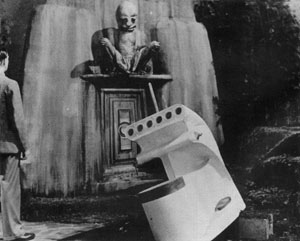
A
group of diminutive, beautiful but frail people appear, dressed in
short robes. One female shows an interest in the Traveller. Their
language is strange, but the Traveller is disappointed to learn they
think he came from the sun on a thunderbolt—hardly the perfect
intellectual society he had hoped to meet. He removes the starting
handle from his machine as he is led to a communal building where
he is given fruit to eat.
The
female communicates that she is called Weena; her people are the Eloi.
The Traveller points out to her where the landmarks of his London
were. Where Wimbledon once was stands a huge palace of green porcelain.
The Eloi couldn't have built it. Weena gives him a flower as he tells
her he wants to travel back to meet the people who made the last remaining
buildings. He returns to the monument—to find that his machine
has gone. He panics, then realizes the Eloi lack the strength to move
it, and he has the starting handle. Someone else has taken it.
The
next morning the Traveller is with Weena when he hears the sound of
machinery coming form a large well. Weena is scared of the well, but
he decides to go down into it.
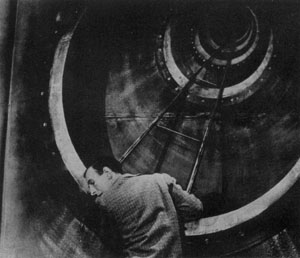
Descending,
he finds a platform, then becomes aware of a number of creatures
in the darkness around him...He has to fight desperately to escape
from them and return to the surface.
The
underground people are the Morlocks, descendants of that part of
the human race which once tended machines. They still do so, but
now feed on the flesh of their one-time masters, the Eloi...The
Traveller and Weena travel to the green palace, and discover it
is a museum. They realize the building is infested with Morlocks,
and escape. As dusk falls the pair reach a wood and rest.
The
Traveller wakes to find himself surrounded by Morlocks. He fights
them off, but Weena is gone.
Returning
once more to the monument, the Traveller notices a bronze door in
it i open, revealing the Time machine inside. He suspects a trap
but goes in. he is grabbed by the Morlocks, but manages to reattach
the starting handle and takes off in the Time machine. He travels
out far into the future, where there are only rocks covered in green
lichen. As he goes onward, the sun grows larger as it ages and decays.
When he stops again he is menaced by giant crabs on a beach, he
travels on, until life is reduced to green slime, then vanishes
altogether. An eclipse by another planet heralds the death of the
sun; and the end of the world...Terrified, the Traveller puts his
machine into reverse. At long last, the laboratory walls reform
around him.
The
Traveller finishes relating his tale to his friends, back in his
living room. He is still dirty and fatigued from his adventure.
The medical man and the psychologist agree he has been overworking,
dismissing the story as a dream. The Traveller laughs—it all
seems to be fading from his mind now. He muses, "But they say
life is a dream," as he fills his pipe. He puts his hand in
his pocket for a match—and brings out the flower he was given.
h says softly, "Weena..."
Background
The
Time Machine, written in 1895 by HG Wells, is one of the most influential
works of early Science Fiction literature. Although it has a very
straightforward narrative structure, any visual production requires
a range of technical effects to depict travel through Time. In January
1949, barely two and a half years after the BBC's fledgling television
service resumed transmission after World War Two, Robert Barr dramatized
and produced the story as a one-hour play. Like any producer of
the time, he was faced with the problem of performing live,which
left no escape should actors forget their lines, or if cameras and
other equipment failed—which they very frequently did.
As
producer, Barr would have combined the roles of yet-to-be-invented
functions of script editor, production associate and, most importantly,
director. Together with the self-imposed mantle of scriptwriter,
this must have made the process o production more cogent in light
of the medium's limitations.
Those
techniques for special effects available in 1949 were used to their
limit. Film was used for both straight inserts and for back projection,
which provided most of the Time travel sequences. A good indication,
albeit in a very whimsical 1940's style, o the problems and solutions
created by Barr and his designer Barry Learoyd, can be found in
the Radio Times article accompanying the first
transmission, 'To the World's End in
Sixty Minutes' by John Swift.
Written
as a parody of the scientific discussion at the start of the play,
it has Barr countering the objections of his colleagues as to how
he will create the Eloi(using casting and clever mock-up) and the
Morlocks (largely to be left to the viewer's imaginations), synthesize
futuristic architecture (the clues are in the book) and depict the
Time journeys themselves (here the article refers mysteriously to
back projection). Learoyd proposes a curverd and elegant Time machine.
The final objections are to the form of dialogue. Barr says he will
invent what is needed, but the Eloi and Morlocks spoke no intelligible
tongue, an to invent one would be pointless as such, Barr's most
telling comment is that 'faint heart never made good television.'
Barr's
adaptation is more faithful to the novel than George Pal's later
film, although he makes necessary cuts for timing, and has less
exposition. The major surgery is to the end, which no longer has
the Traveller going back to the future, but ends with him realizing
his experiences were real. The style of the script is remarkable
to modern eyes in that it is the form of one continuous scene, but
then television at this stage was made by people with experience
of radio rather than films, and was per force done as a continuous
strand. The only out-of-sequence recording was on a 78 rpm disk
(number DLO 46072), cut in Broadcasting House. Although film telerecording
had been experimented with as early as 1947 this was very primitive
and it was not until the early 1950's that program began to be preserved
in any number.
After
outside rehearsals at 31 Beaunont Mews from the 11th to the 22nd
of January, and a day's pre-rehearsal in the studio, The Time
Machine was transmitted live from Studio A at Alexandra Palace
from 8:30 pm to 9:30 pm on the 25th January 1949. Judging from letters
to Radio Times, viewer reaction was divided between
those who found it so 'tiered and impossible' that they could not
enjoy it, and those who marveled at the technical achievement and
escapism, although one writer complained of intrusive off-camera
noises in the studio. With no technology to record the original
performance, a 'revised production' of The Time Machine was
televised on Monday 21st February 1949 at 9:15 pm.
Edward Glenn
The
following is from Radio Times
the week of January 21, 1949.
| From
the section titled
TALK OF THE WEEK
The
Man in the Saddle
'What, another
problem to be solved?' queried the leading man. 'The riddle
of the Sphinx? Well, it will be a change from murder, anyway.
Yes, it will be amusing to investigate the future instead of
the past.'
That
was more or less what Russel Napier said when Robert Barr offered
him the role of the Time Traveller in his production of H.G.
Wells' The Time Machine. In the past, detective parts
have fallen to Napier, such as those in the reconstructed crime
No Other Woman and the premiére of Max Catto's
Kid Flanagan. He will be in the saddle of the Time
Machine on Tuesday, but at the moment he has as little idea
of what he will find in the future a we have—a good basis
for spontaneous acting. |
8.30
H.G. Wells'
'THE
TIME MACHINE'
A
fantastic voyage into the future
The
story of a time traveller who projects himself into the year
802,870 A.D., and journeys onwards into the twilight of the
world.
Adapted
and produced for
television by Robert Barr
Production
designed by
Barry Learoyd
|
|
To
The World's End in Sixty Minutes
They
were talking about re-creating The Time Machine as a
television drama. It was a small gathering, not unlike that
which Wells himself conjured up fifty-odd years ago as the preliminary
to the flight through Time of his fantastic contraption of brass,
nickel, ivory, quartz, and heaven -knows-what. The Man-in-the-Corner
might well have been the Medical man. You may recall that he
was not too anxious to be mixed up in the affair—he had
a reputation to maintain.
'I
don't believe it's possible to do it', said the Man-in-the-Corner.
He said it with an air of finality. He was not imaginative.
'Now
if you put the Machine in reverse,' opined the Stout Little
Man with the waxed mustache (he would be ideally cast as the
Provincial Mayor), 'I'd say you could do it. You'd know what
you were about, if you see what I mean,' and he went on to tell
of an aged film, something about a Yank at the Court of King
Arthur. He had imagination, but it went backwards—the
Wellsian Time traveller did not.
It
was the tall, lean man with an evil-smelling-pipe—let us
call him the Psychologist—who was in his element, probing
into the minds of two men who believed they could interpret
these Wellsian imaginings in visual form. If they refused defeat,
why should he? But, he could think of no way out.
'Surely,'
he said, 'everyone of us has a different conception of practically
every being and thing in the book. My interpretation of the
sunset of mankind may be entirely different from that of my
butcher or coal merchant, so how can you put it in pictures?'
'Talking
of pictures.' I interjected, 'I did hear tell of a film company
that got The Time Machine on the stocks. The scriptwriters
had to have aspirins for breakfast every morning and in the
end everybody concerned gave up the ghost.'
'There,
I told you!' said the Man-in-the-Corner, and the Stout Little
Man nodded knowingly.
The
Producer had taken little part in this conversation, but the
problems propounded on all sides were as a bit between the teeth.
'All
right!' he said, 'I know it's not easy, and I know
we all have our own idea about every single thing in the book.
I read it when I was twelve. I read it last week and my idea
of it is still much the same. But it may not be everybody else's
idea. Millions of people have read and reread it, and if nobody
has attempted to interpret it visually then it's time someone
did. We may succeed, we may not, but faint heart never made
good television—if you will forgive the metaphor.'
'And
I'm with you.' said the Scene Designer at last, He had hoped,
by keeping his piece, to pick up some ideas of the shape of
a land crab three-million years hence or a suburban house in
a mere 25000 A.D. But nobody yielded any ideas.
'You've
both decided you're really going to make a shot at it?' asked
the Psychologist.
'Yes'
'Right.
Now let's consider just a few of the problems. At the very beginning
you will have to make the Time Machine disappear from the Time
Travellers dining room?'
Indulgently,
the Producer and Designer smiled. That was an easy one, but
every man to his trade.
'And
what about the delicious people of the Golden Age, the Eloi?'
'That,'
said the Producer, 'is a matter of casting—and clever make-up.
They will have to be of small stature with delicate features
and voices pleasing to the ear. Wells gave us enough detail
to go on. I think most of us have a similar idea, at least ,
of the Eloi.'
'And
those dreadful Morlocks underground?'
'Ah,
now that's a different proposition. They were loathsome creatures,
but fortunately they lived in darkness. That is where the viewer's
imagination will play a big part.'
The
Stout Little Man wriggled himself up from his armchair. 'Yes,
we'll accept the people.' he began, 'but what about the things—houses,
roads, methods of transport, dress, even in the next hundred-thousand
years?'
'My
dear chap,' replied the designer, 'Imagination—assisted
by Mr. Wells! He has given us a number of hints; the great,
bubble-shaped mass homes which I have in mind for the Eloi,
for instance, are not beyond possibility. But in any case, the
next few hundred-thousand centuries flashed by in moments, Remember
"The slowest snail that ever crawled dashed by too fast
for me...the palpitation of night and day merged into one continuous
greyness..."?'
'Ah,
there you are now.' cried the Psychologist, seizing on a point,
'You can't alter nature. You might do wonders with lighting
tricks, but you can't replace whole scenes every tenth of a
second.'
'Then
we'll put it on film,' explained the Producer. 'Use the time
traveller himself "live,"—but that's a technical
matter, We ought to cover 800,000 years or so in two-and-a-half
minutes.'
The
Man-in-the-Corner, thinking hard all this time, produced his
trump card.
'And
what, may I ask, does a Time Machine look like?'
The
designer looked puzzled. 'Well,' he said, 'It's ...it's sort
of...oh, you know,' and he began to demonstrate vaguely with
his hands, rather like a salesman selling one of those American
cars that may be either coming or going.
'It
was all nuts and bolts and cog wheels and bits of jutting machinery
in my days,' said the man-in-the-Corner, meaning to be helpful.
'Rubbish,'
declared the Designer. 'Any man of science engaged on such a
project would think in terms of curves and parabolas and all
that.'
Then
I thought of something. 'But,' I said, 'The Time Machine
is a fantastic story told by one man. What about dialogue?'
'I
shall have to write it, that's all,' was the Producers only
answer.
'Maybe,
but the Morlocks and Eloi didn't speak any understandable language.
Wells gave little idea of how they spoke.'
'No?
And suppose he did? Suppose there were a Morlock and
Eloi language and we did put the play in it? That wouldn't achieve
what we set out to do , would it?'
Which
is as good an answer as any. And so the discussion went on.
That was three weeks ago. The Producer (Robert Barr) and Designer
(Barry Learoyd) have used up a lot of pencils and paper since
then and we shall see their version of The Time Machine this
week. It should be interesting.
John
Swift (Radio Times) |
Thanks
to Derek Johnston for submitting these additional articles
| Into
the Future
"Not a few people would jib at the prospect of turning that
fantastic Wellsian romance The Time Machine into visual entertainment.
Robert Barr is one who believes that it can be done in the form
of a drama-documentary and is already putting the finishing
touch to his script. Most of us have read how Mr Wells made
time reel past in our minds, but it is another thing to make
time career forward 800,000 years on the screen, past the golden
era, into the sunset of mankind, and on to the world's end.
"Barr calls this production a 'visual experiment,' and it is
only being made possible by the most careful collaboration between
him and scene designer Barry Learoyd. A new picture-script system
is being used to simplify the matching and the superimposition
of pre-shot film sequences and futuristic models." The Scanner,
"Talk of the Week", Radio Times, 14 January 1949, p.24
The Man
in the Saddle
"What, another problem to be solved?" queried the leading
man. 'The riddle of the Sphinx? Well, it will be a change from
murder, anyway. Yes, it will be amusing to investigate the future
instead of the past.' "That was more or less what Russell Napier
said when Robert Barr offered him the role of the Time Traveller
in his production of H.G.Wells The Time Machine. In the past,
detective parts have fallen to Napier, such as those in the
reconstructed crime No Other Woman and the premiere of Max Catto's
Kid Flanagan. He will be in the saddle of the Time Machine on
Tuesday, but at the moment he has as little idea of what he
will find in the future as we have - a good basis for spontaneous
acting."
The Scanner, "Talk of the Week", Radio Times, 21 January 1949,
p.24
The Time
Machine' Experiment
"As a regular (and very satisfied) viewer I wonder how
many will join me in congratulating the producer and all concerned
in The Time Machine? I was sorry when the programme came to
an end."
(Mrs.) Gladys Hemming,
"Viewers Are Saying", Radio Times, 4 February 1949, p.25
"Must we
be afflicted with a repeat of The Time Machine? Surely, there
are no viewers who want to see it a second time. Am I so lacking
in intelligence that I could not appreciate the fantasy? It
was so weird and impossible I could not get the least bit interested
in it and felt quite relieved when it was over."
A.G.Wrench,
"Viewers Are Saying", Radio Times, 4 February 1949, p.25
"The Time
Machine was a very good attempt at a difficult subject. But
the noises in the studio during the showing very nearly spoilt
the whole performance."
A.R.Leman,
"Viewers Are Saying", Radio Times, 4 February 1949, p.25
Understanding
'The Anatomist'
" Most of the programmes these days are excellent, but
there are a few which could be improved upon. For instance The
Anatomist was a play which only a few people could understand.
If you had half-an-hour or even an hour of comedy films one
evening a week a greater majority if people would enjoy the
programme. The Time Machine was produced with remarkable ingenuity
and there was some very good acting by Russell Napier, but wasn't
it rather short? Surely it could have gone on for the other
half-hour."
G.Wingate (letter),
"Viewers Are Saying", Radio Times, 11 February 1949, p.25
Believe
It or Not
"Most of you know that stop-watches are indispensable to
both radio and television producers. A short time ago a programme
was due to go on the air when the producer found that his stop-watch
had jammed. He borrowed one from a colleague. Something went
wrong with that, too, so he sent for a third. Whether it was
personal magnetism, or some sort of hoodoo I don't know, but
even that one turned temperamental. The programme, by the way,
was - The Time Machine!"
The Scanner, "Talk of the Week" , Radio Times, 4 March 1949,
p.29 |
Notes
: Russell Napier was born 1910 in Perth, Australia. His later
credits include turning up as a variety of police inspectors
in several episodes of the 50's series Scotland Yard (Inspector
Harmer in The Strange Case of Blondie and Inspector Hammond
in The Dark Stairway before becoming the regular character of
Inspector Duggan from 1956). His film roles include Hell Is
A City (1960), The Bloodbeast Terror (1967) as the pub landlord
and Twisted Nerve (1968). One of his last appearances before
his death in 1974 was as Admiral Ballantyne in the film The
Black Windmills.
Robert Barr was born in 1909 and was
a BBC radio correspondent in WW II. He died in January 1999.
Production
designer Barry Learoyd went onto work on a series of TV adaptations
of the works of William Shakespeare throughout the fifties as
well as the classic Kneale and Cartier version of 1984. He would
also work on the anthology show Out Of The Unknown.
|
|


